

I’m not the biggest fan of horror movies: so many of them are so… samey, and the sameyness they embody does not interest me. But Censor is… not samey. It is something beyond.
This is a horror movie explicitly about horror movies, in a way far more introspective and thoughtful than I’ve seen before. (Though I concede there are probably some I’d like that I’ve missed, given my bias here.) Censor is meta, but not like, say, how The Cabin in the Woods (which I adore) is meta. This is a film that examines on multiple levels how we digest horror movies, how they linger with us and, dare we admit it, how they infect us.
The potential controversy of that last supposition is what is happening overtly in the story here. Enid Baines (a terrific and deeply empathetic Niamh Algar) works for the UK agency that rates movies — no one here says “British Board of Film Classification” or “BBFC,” but that’s what it is — and sometimes she has to insist on certain cuts in films in order for those films to pass for theatrical exhibition and video release. You know, like: “The eye gouging in that one scene is a bit extreme and has to be trimmed.” (Not a direct quote, but close enough.)
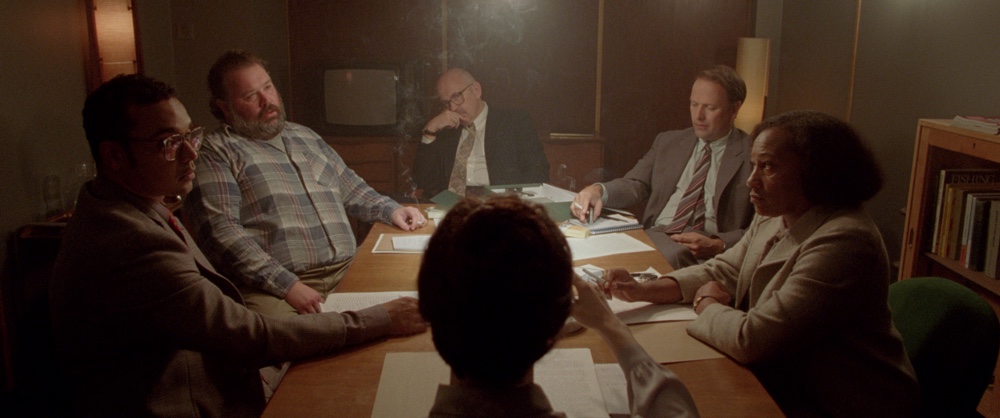
Cuz, oh yes, it’s the 1980s here — early to mid 80s, judging from the general dun color and depressing demeanor of everything; the production design is gloriously, deliberately, accurately wretched — and “video nasties,” as they were disparaged in the UK, are all the rage, when they can get passed by Enid and her coworkers… and maybe even more so when they aren’t passed, and ended up as bootleg videos surreptitiously shared around by fans of extreme gore. (Somehow 1980s US seemed to avoid condemning movies on video with quite the same vehemence as the UK managed. We had pearl-clutching over pop music instead.)
Enid is smart, professional, and unflappable, even in the face of the low-budget cinematic exploitation she watches day after day. (We are spared most of what she sees in her work.) But it starts to get to her after news breaks of a violent crime that appears to mirror something in a film she recently passed… and as she is haunted anew by the disappearance of her sister, back when they were both children, in mysterious circumstances that Enid cannot quite recall. And then another movie crosses her desk that echoes what little she does remember of her sister’s vanishing.
Or does it? Is it all in Enid’s confused mind? The ways in which horror films can help us cope with trauma — I grant this may be true even though it’s not a thing that works for me — clashes with the (much disputed) notion that nasty, explicit violence onscreen goads some of us into replicating such savage fantasies in real life.

Welsh writer (with Anthony Fletcher) and director Prano Bailey-Bond, making her feature debut, remains solidly in the realm of the ambiguous and the conjectural here, making no judgments and casting no aspersions on the genre. But she is sharp and astute as she asks us to consider whether the gore she deploys — of which there is plenty, some of it righteous and even funny — isn’t having an impact on us. Maybe a tiny one. Maybe an inconsequential one. But an impact nevertheless. Indeed, why else watch it if it doesn’t affect us?
We are sensory creatures. We absorb sights and sounds to form memories, and we replay those memories, sometimes, as the cinema of our minds. Do movies intrigue us because they are like memories? Do movies alter those memories… and if so, might horror movies do something terrible to those memories? Is that what is happening to poor Enid?
One reason why I don’t like much of what is offered as horror is because it often little more than pure indulgence of the audience’s appetite for terror and bloodshed. But Censor does not pander like that. It demands much more of us… and so is as weirdly uncomfortable, as existentially disconcerting as horror should be, and, I find, rarely is.














Like you, I don’t usually go for Horror (except for the campy Hammer Horror of the 60s) – but this is intriguing!
Being a die hard horror fan, I love this one. It’s very wink-wink nudge nudge if you know the cliches they are aaaalllmooost parodying. And setting a horror film during the video nasties era of British censoring which also took place during the Thatcher era, which is no coincidence, is gold. I love horror films that question a viewer’s participation in the proceedings and the fact that, as you said, how it can be helpful in dealing with trauma. Though, in poor Enid’s case, maybe not so much. And the film director in the end is a pitch perfect parody of the conceited director with grand ideas yet can’t seem to find money for a budget and can’t recognize the actress that he cast isn’t the actress he’s looking at. Can’t wait to see what Bailey-Bond comes of with next.
This movie is for man-hating Horror cynics. I hated it because I like real horror cinema
What’s this “real horror” that you like, and how does this movie not qualify?